
There was a woman whose face came to embody Hollywood glamour itself. Her image traveled with American servicemen during World War II. Her photographs filled magazines, barracks, and lockers. On screen, she moved with the discipline of a dancer and the mystery of a woman who seemed to know more than she would ever reveal.
They called Rita Hayworth the Love Goddess.
It was a title that sounded like a triumph. In truth, it concealed a life shaped by control, reinvention, public desire, private insecurity, and finally, a devastating illness that slowly took away the woman behind the image.
Rita Hayworth became one of the most unforgettable stars of classic Hollywood. Yet near the end of her life, she could no longer recognize the face that millions had adored. Her story is not simply about fame fading. It is about Margarita Carmen Cansino, the dancer’s daughter who was remade into Rita Hayworth, and whose final years helped bring Alzheimer’s disease out of the shadows.
Before Rita Hayworth, There Was Margarita Cansino
Margarita Carmen Cansino was born in Brooklyn, New York, on October 17, 1918. Performance was not merely part of the family business. It was the family inheritance.
Her father, Eduardo Cansino, was a Spanish dancer who had built a career in vaudeville. Her mother, Volga Hayworth, had performed with the Ziegfeld Follies. From childhood, Margarita was trained to dance with intense seriousness. By six, she was performing with her parents. By twelve, she was dancing professionally in clubs and casinos near the California and Mexico border.
It was demanding work for a child. The hours were late, the crowds could be rough, and the environment was far removed from anything resembling an ordinary childhood. But it gave her the command of movement that would become one of her greatest strengths.
After the family moved to Los Angeles, Eduardo opened a dance studio near Sunset and Vine and found work as a choreographer at Fox. Margarita continued in the family act, learning not only routines but the essential discipline of performance: timing, posture, rhythm, endurance, and the ability to appear effortless under pressure.
That training made her exceptional. Long before Hollywood turned her into a symbol, she was a working dancer.
The Reinvention That Created Rita Hayworth
In 1935, teenage Margarita met Edward Judson while performing at the Foreign Club in Tijuana. Judson was a businessman and promoter, more than twice her age, who saw commercial potential in the young dancer. He promised he could make her a star.
They married in 1937. The marriage launched a systematic transformation of Margarita Cansino into a Hollywood product.
Judson believed her name sounded too Latin American for the kind of stardom he envisioned. He combined a shortened form of Margarita with her mother’s maiden name, turning Margarita Cansino into Rita Hayworth. Then came the physical changes. Her naturally dark hair was dyed auburn. Her hairline was altered through painful electrolysis treatments that continued for two years.
The changes were not trivial matters of styling. They reflected an industry that demanded conformity and treated identity as something to be edited for marketability. Rita’s Spanish heritage was softened, concealed, and repackaged to fit Hollywood’s narrow standards of beauty.
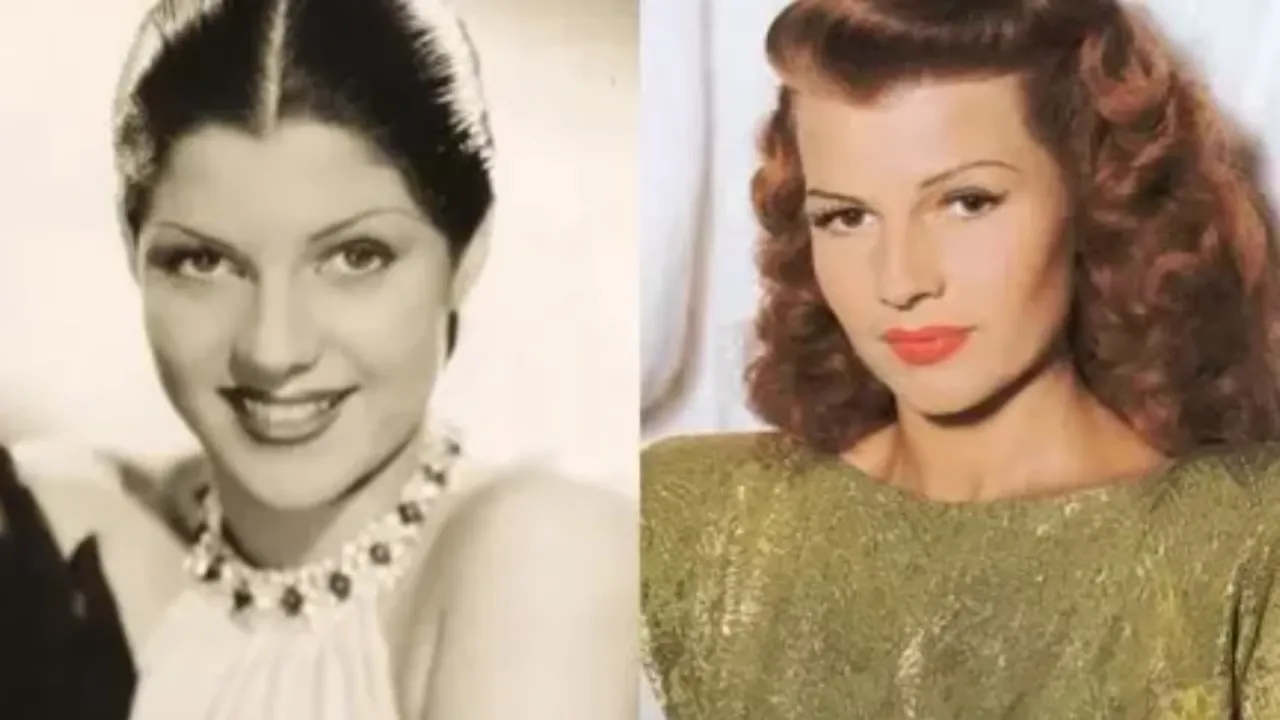
Judson worked tirelessly to secure publicity, screen tests, and connections. Columbia Pictures signed Rita to a seven-year contract in 1937. But the career opportunities came with a terrible cost. Judson controlled her finances and directed her income into investments and accounts she did not understand.
Rita later described him as jealous, controlling, and argumentative. She said she was made to feel incapable of making decisions for herself. Her personality, she believed, retreated deeper into a shell.
When she filed for divorce in 1942, citing cruelty, she was left financially damaged despite years of steady work. The marriage had opened Hollywood’s doors, but it had also taught her a lesson she would carry through much of her private life: that people could admire her, pursue her, even profit from her, without truly protecting her.
The Rise of the Love Goddess
Once free of Judson, Rita Hayworth’s career surged. Her breakthrough came in 1939 with Only Angels Have Wings, where she appeared opposite Cary Grant. The role showed that beneath the glamour was an actress capable of emotional complexity.
In 1941, she appeared with James Cagney in The Strawberry Blonde and danced with Fred Astaire in You’ll Never Get Rich. Astaire, famously exacting and sparing in his praise, would later call Hayworth his favorite dance partner.
That praise mattered. Rita was not simply beautiful in a gown under studio lights. She was technically gifted. The discipline of her childhood had survived Hollywood’s makeover. She could hold her own with Astaire because she understood dance from the inside out.
In the same period, Life magazine helped cement the image that would follow her everywhere: the Great American Love Goddess. The name fit the public fantasy. Her auburn hair caught the light, her smile suggested secrets, and her screen presence had a rare combination of confidence and vulnerability.
Then came the famous 1944 pinup photograph. Rita, kneeling on a bed in black lace, became an unofficial symbol of longing for American servicemen overseas. Millions of copies circulated during World War II. Her image was carried across continents by men who had never met her and could not know the person behind the pose.
Rita was aware of the attention and did not reject it. She remembered the years when no one wanted to photograph her. Glamour had become part of her work, and she accepted its power. But the gap between the public fantasy and the private woman would grow wider with time.
Gilda and an Immortal Screen Image
In 1944, Cover Girl paired Rita with Gene Kelly and confirmed her place among Hollywood’s biggest names. But it was 1946’s Gilda that made her immortal.
As Gilda, she played a woman who was at once seductive, wounded, manipulative, and vulnerable. The film’s noir atmosphere allowed Hayworth to bring real danger and sadness to a character who might otherwise have been reduced to a glamorous temptation.
The most famous scene involved the song “Put the Blame on Mame.” Her striptease consisted largely of removing one long black glove, yet it became one of cinema’s most celebrated moments. The power was never in how much she revealed. It was in the control of the gesture, the flip of her hair, the defiance in her gaze, and the sense that the character was daring everyone in the room to misunderstand her.
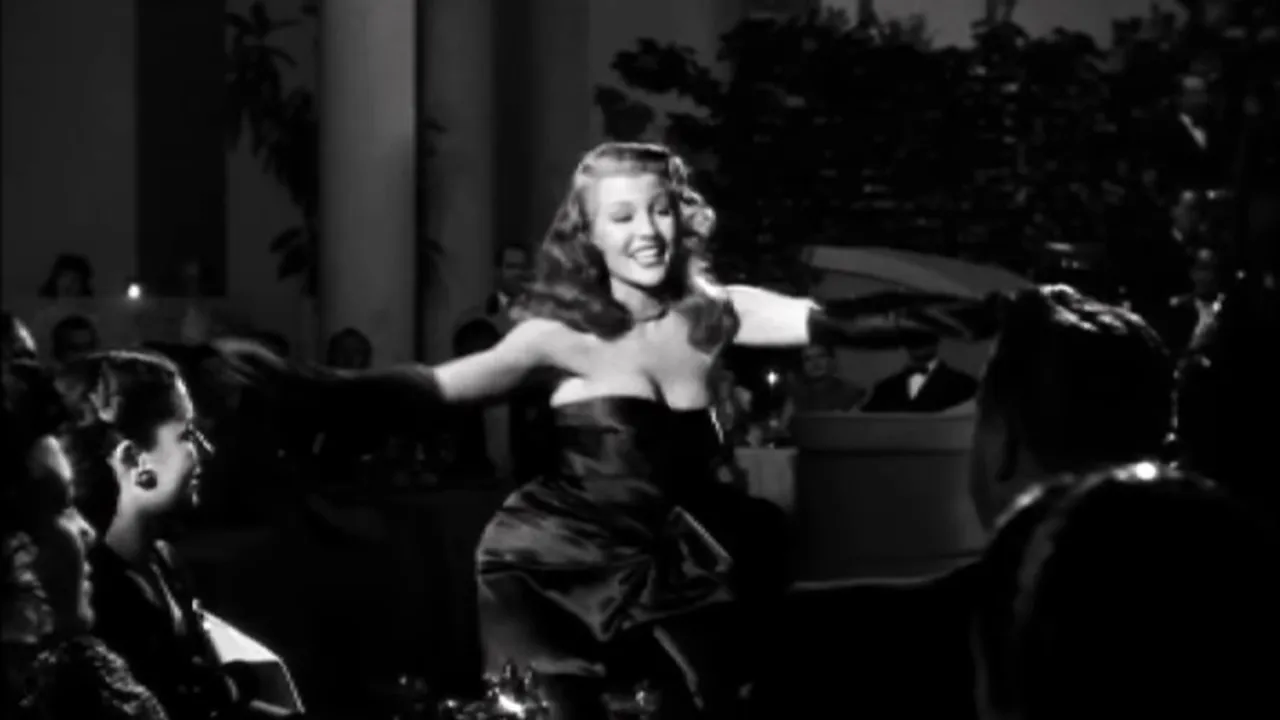
Rita later captured the tragedy of her celebrity with one of her most famous observations: men fell in love with Gilda, but woke up with Rita. It was a sharp description of the divide between the fantasy people wanted and the person she actually was.
Love, Marriage, and the Search for Stability
Rita Hayworth married five times. Her relationships were often treated as glamorous Hollywood headlines, but beneath the headlines was a repeated search for security, affection, and a sense of belonging that fame could not provide.
Orson Welles
Orson Welles saw Rita in a magazine photograph and became determined to meet her. He was already one of the most celebrated young figures in American cinema after Citizen Kane. They married in 1943, when Rita was twenty-four and Welles was twenty-eight.
For a time, they appeared deeply happy. Their daughter, Rebecca, was born in December 1944. But Welles was not suited to domestic stability. Within two years, the marriage was unraveling. Rita wanted a home and a settled family life. Welles resisted the responsibility and later admitted that marriage conflicted with his need for freedom.
They separated in 1946 and divorced the following year, although they reunited professionally for The Lady from Shanghai. Welles gave Rita one of her most challenging dramatic roles, but also cut and bleached her famous hair for the film. Columbia chief Harry Cohn was furious. The studio had spent years constructing the Rita Hayworth image, and Welles had altered its most recognizable feature.
The film was acclaimed but disappointed commercially. Audiences wanted the Love Goddess, not an art-film blonde. Yet the role remains important because it proved Hayworth’s range extended far beyond the image Hollywood had built around her.
Prince Aly Khan
While her marriage to Welles was collapsing, Rita became involved with Howard Hughes. After a painful and emotionally devastating pregnancy, she left for Europe. There, on the French Riviera in 1948, she met Prince Aly Khan.
He was charming, wealthy, glamorous, and the son of Aga Khan III, the spiritual leader of the Ismaili Muslim community. Their romance became international news. When they married in 1949, Rita Hayworth became Princess Rita in what appeared to be a real-life fairy tale.
She announced that she was leaving Hollywood and gave birth to their daughter, Princess Yasmin Aga Khan, later that year. But Aly Khan’s reputation as a playboy was not transformed by marriage. His affairs and restless social life left Rita feeling out of place in a world where she was expected to play princess while being reminded that she was, in the eyes of many, still a Hollywood actress.
The marriage ended in 1953. The divorce brought a bitter custody battle over Yasmin and competing visions for their daughter’s religious upbringing. Aly Khan’s death in a 1960 automobile accident ended the legal struggle, but the years of conflict had taken a severe emotional toll.
Dick Haymes and James Hill
Rita’s marriage to singer Dick Haymes began quickly after her divorce from Aly Khan and descended into turmoil. Haymes had serious financial and legal problems and became increasingly controlling. In 1955, he struck Rita in the face at the Coconut Grove nightclub in Los Angeles. She left him and divorced him that same year.
Her fifth and final marriage, to producer James Hill, began in 1958. Hill wanted Rita to continue working while her name still carried box-office weight. Rita wanted a quieter life away from Hollywood. Their opposing visions became impossible to bridge, and she filed for divorce in 1961, citing extreme mental cruelty.
At forty-two, Rita Hayworth had been married five times. She would not enter another serious relationship. For someone branded the Love Goddess, the later years of her life became increasingly isolated.
When Memory Began to Slip
By the early 1960s, friends and colleagues noticed changes. Rita began repeating questions in conversations. She seemed confused by simple matters. Her daughter Yasmin, away at boarding school, found their weekly calls increasingly distressing because her mother seemed unable to retain information from one moment to the next.
In films, her work became more difficult. She struggled to remember dialogue and needed more takes. On set, she sometimes seemed uncertain of where she was supposed to be or what she was supposed to do.
In the early 1970s, she was offered a major opportunity: replacing Lauren Bacall in the Broadway production of Applause. It should have been a triumphant return to the stage. Instead, Rita found that she could not retain a play’s worth of dialogue, no matter how many times she rehearsed. She withdrew, humiliated and confused.
Her final film, The Wrath of God, arrived in 1972. She was only fifty-four, but her career was effectively over.
At the time, many people blamed alcohol, emotional instability, trauma, or difficult behavior. The press published harsh stories and unflattering photographs. When she experienced an angry outburst on a TWA flight at Heathrow Airport in 1976, the public response was cruel and sensational.
But Yasmin sensed that something larger was happening. The memory loss, confusion, rage, and disorientation did not seem fully explained by substance use or emotional distress.
The Diagnosis: Early-Onset Alzheimer’s Disease
In 1980, after comprehensive testing, Rita Hayworth received the diagnosis that finally gave the family an answer: early-onset Alzheimer’s disease.
The diagnosis brought no cure and no easy relief. But it changed the meaning of the years that had come before. Rita had likely been experiencing symptoms since the late 1950s or early 1960s. For two decades, the disease had been mistaken for alcoholism, personal instability, or the aftermath of a difficult life.
Alzheimer’s does not merely take away names and dates. It dismantles a person in stages. Recent memories often disappear first. Then older memories. Eventually, even the practical and physical abilities that make independent life possible begin to vanish.
For Rita, the cruelty was especially sharp. She had spent much of her life being shaped into a public identity. Then she began to lose both identities, Rita Hayworth the star and Margarita Cansino the dancer’s daughter.
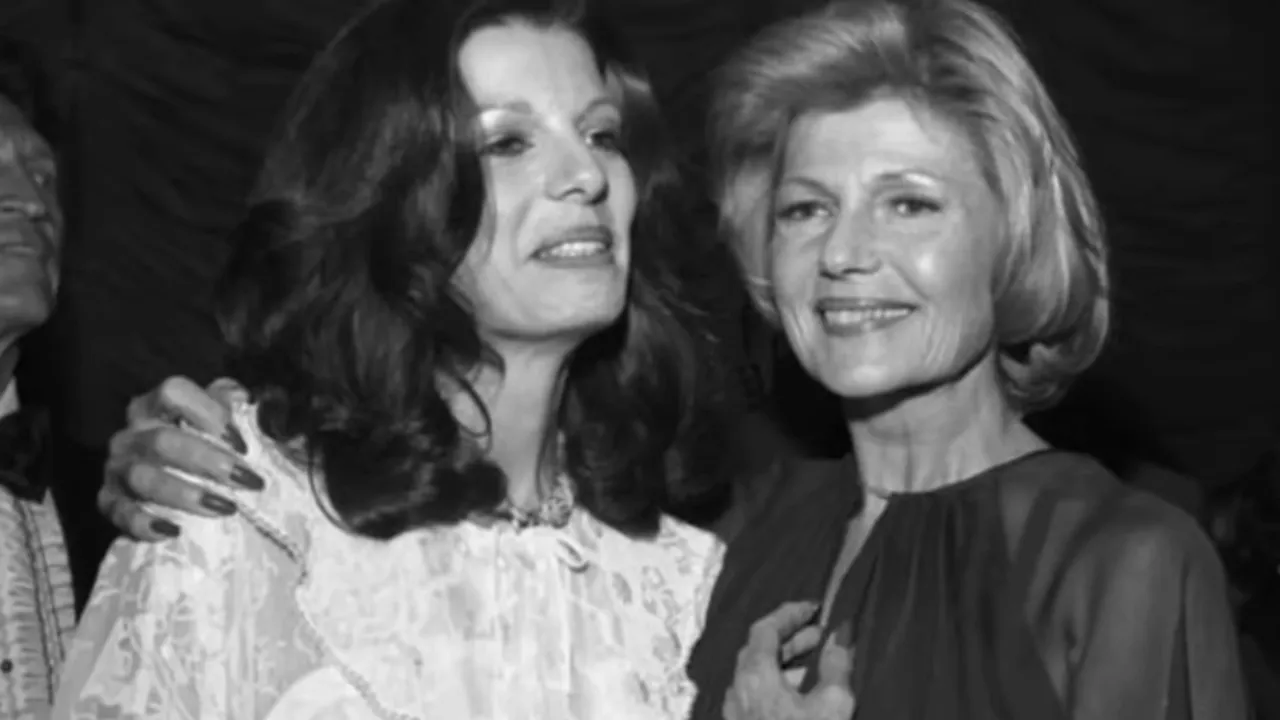
Yasmin moved Rita into her New York apartment and took on the overwhelming responsibility of full-time care. Rita could not safely cook, manage medication, or go out alone without risking becoming lost.
There were moments when Rita looked at photographs from Gilda and asked who the beautiful actress was. When Yasmin explained that it was her, Rita would laugh as if it were impossible. She could not believe that the glamorous woman in the photograph had ever been herself.
The angry outbursts that had long been judged as personality flaws were also understood differently after the diagnosis. Alzheimer’s can make emotional regulation and cause-and-effect reasoning difficult. Rita might lash out, forget the incident minutes later, and be unable to understand why Yasmin was upset.
By the mid-1980s, Rita needed round-the-clock care. The dancer who had moved with such precision beside Fred Astaire and Gene Kelly could no longer dress herself, eat easily, or walk independently.
How Rita Hayworth Became a Symbol for Alzheimer’s Awareness
In 1984, Yasmin Aga Khan made a brave and consequential decision. She went public with her mother’s diagnosis.
At that time, Alzheimer’s disease was rarely discussed openly. It carried stigma and shame. Many families dealt with it in silence, often without clear information or support. Yasmin understood that her mother’s fame could help make the disease visible.
She organized the first Rita Hayworth Gala in New York City to raise money for Alzheimer’s research. It brought together glamour, celebrity, fundraising, medical advocacy, and media attention in service of a disease that had too often been hidden away.
The impact was profound. The galas raised substantial funds and helped bring national attention to Alzheimer’s research and dementia care. Yasmin became a leading public advocate, speaking honestly about caregiving, memory loss, and the need for better understanding.

The publicity surrounding Rita’s illness was unprecedented. Federal funding for Alzheimer’s research increased significantly in the years after her diagnosis became public. The Rita Hayworth Gala became an enduring model for how celebrity advocacy could create real attention for a medical crisis.
In 2022, Yasmin was recognized by the French government with the Legion of Honor for her work raising Alzheimer’s awareness around the world. It was another chapter in a legacy created from unimaginable loss.
The Final Days of Rita Hayworth
By early 1987, hospice care was being considered. Rita spent most of her time in bed, drifting in and out of consciousness. The vibrant personality that had captivated Hollywood had been almost entirely overtaken by the disease.
In February, she lapsed into a semicoma. Yasmin stayed by her side as her mother’s responses grew weaker.
On May 14, 1987, Rita Hayworth died in the Manhattan apartment she shared with Yasmin. She was sixty-eight years old. The cause of death was complications associated with Alzheimer’s disease.
Tributes came from around the world. President Ronald Reagan called her one of America’s most beloved stars and acknowledged the public service created by the openness surrounding her illness. Her funeral was held at the Church of the Good Shepherd in Beverly Hills, with friends and colleagues from her peak years among the pallbearers.
She was buried at Holy Cross Cemetery in Culver City, California. Her headstone bears an inscription chosen by Yasmin: “To yesterday’s companionship and tomorrow’s reunion.”
Rita Hayworth’s Legacy Is Larger Than Tragedy
It is easy to tell Rita Hayworth’s life as a tragedy. The story has all the elements: beauty, fame, exploitation, failed marriages, illness, and loss. But that is not the whole story.
She was a gifted dancer who earned Fred Astaire’s admiration. She gave classic performances in Gilda, Cover Girl, You’ll Never Get Rich, The Lady from Shanghai, and Separate Tables. She survived an industry that routinely remade women, used them, and discarded them when their youth or marketability began to fade.
Her life also reveals the cost of Hollywood’s old system. Margarita Cansino had to change her name, erase visible parts of her heritage, alter her appearance, and inhabit an identity that was not entirely her own. She became one of the most desired women in the world while often feeling deeply insecure in private.
Yet the story does not end with a woman forgetting who she was.
Because of Yasmin Aga Khan’s advocacy, Rita Hayworth became a face for Alzheimer’s awareness at a time when the disease was rarely named aloud. The woman whose mind was taken by Alzheimer’s helped the world remember that millions of families were facing the same pain.
The films remain. So does the dancing, the vulnerability, the glamour, and the extraordinary presence that made Rita Hayworth impossible to forget.
Frequently Asked Questions
What was Rita Hayworth’s real name?
Rita Hayworth was born Margarita Carmen Cansino on October 17, 1918, in Brooklyn, New York. Her name was changed early in her Hollywood career as part of an effort to make her appear less ethnically identifiable.
What movie made Rita Hayworth a major star?
Rita Hayworth became a major Hollywood star through films including Only Angels Have Wings, The Strawberry Blonde, You’ll Never Get Rich, and Cover Girl. Her defining role came in 1946 with Gilda.
Why was Rita Hayworth called the Love Goddess?
The nickname emerged during the height of her fame in the early 1940s. Her glamorous screen image, magazine publicity, and hugely popular World War II pinup photograph made her a symbol of desire for an entire generation.
Who were Rita Hayworth’s children?
Rita Hayworth had two daughters. Rebecca Welles was her daughter with Orson Welles, and Princess Yasmin Aga Khan was her daughter with Prince Aly Khan.
What illness did Rita Hayworth have?
Rita Hayworth was diagnosed with early-onset Alzheimer’s disease in 1980. Her symptoms had likely begun years earlier and were initially mistaken for alcoholism, emotional distress, or difficult behavior.
How did Rita Hayworth influence Alzheimer’s awareness?
Her daughter Yasmin Aga Khan publicly disclosed Rita’s diagnosis in 1984 and created the Rita Hayworth Gala to raise money for Alzheimer’s research. The campaign helped reduce stigma and brought major national attention to the disease.